Criminal Justice Made Easy Easier
Henry WaldockLast Updated: 2011-11-02
This page explains the basics of criminal trial procedure in
Canada. Many of the words are defined in this dictionary
of court jargon.
Laying a Charge
When the media says "Police Laid Charges..."
... the public thinks that every criminal goes to jail.

If it were that simple, we wouldn't need police or
prosecutors. In reality, each arrow here only happens some of the
time.
Police Laid Charges
Except in B.C., New Brunswick and Quebec, the police who investigate decide whether to lay charges.

Crown Charge Approval
In B.C. New Brunswick and Quebec, the prosecutors decide whether to lay the charge.

The test which prosecutors use varies slightly from province to province:
| B.C. |
New Brunswick |
Quebec |
| Is there a "substantial likelihood
of conviction", and is prosecution in the public interest? |
Is there a "reasonable prospect of
conviction" and does the public interest "require a prosecution"? |
See this
link. |
In B.C., prosecutors approve of a charge only if:
-
There is a substantial likelihood of conviction; and
-
Prosecuting the case is in the public interest.
This extra step before charges are laid places pressure on police to complete the investigation and documentation, especially when the suspect was arrested, and must be brought to court within 24 hours.
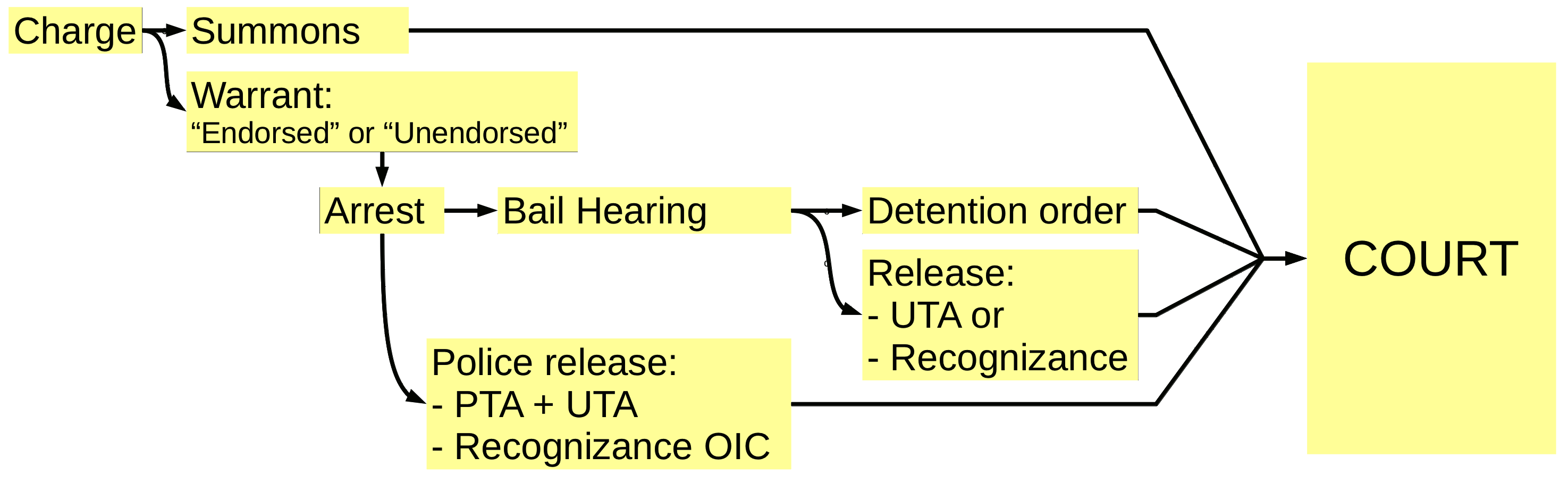
"Process" - Compelling the Suspect to Attend Court
The Criminal Code provides several ways
to make a suspect attend court to answer to charges. These depend
upon which occurs first: the arrest or the charge.
Arrest or Appearance Notice at time of
investigation

Compel appearance after Charge
Sometimes, the charges are laid first, and then someone tells the
accused to attend court.
"Elections"
All criminal charges start in Provincial Court. However, with most offences, the prosecutor may choose whether to proceed:
- "summarily" - faster procedure but lower penalties
- "by indictment" - slower procedure, but higher penalties
If the prosecutor chooses to proceed by indictment, then the defendant usually gets to choose the mode of trial. Those choices trial by a provincial court judge, or a trial by superior court judge with, or without a jury.
These choices are called "elections". There are lots of exceptions which limit the prosecutor's and defendants' choices. Some offences can be prosecuted only summarily, such as causing a disturbance. Some offences can be prosecuted only by indictment, such as B&E of a residence.
If the defendant chooses a superior court trial, then the defendant or the prosecutor can require the court to hold a "preliminary inquiry", which is like a slimmed-down trial.
Basically, it looks like this:

| Top
|
Home
|
Contact |